NEET Rates and The Case for Place-Based Preventative Action
Erica Fletcher, Senior Researcher at the Growth and Reform Network, explores the case for place-based prevention to address NEET rates.



The challenge of young people not in education, employment, or training (NEET) is both a social challenge and a critical economic issue. NEET rates are composed of two groups: unemployed, who are actively looking for work, and economically inactive, who are not looking for work. Nearly one million 16-24 year olds in the UK are NEET, and 61% of those young people are economically inactive. This has costly consequences; it is estimated that a person leaving the workforce in their 20s can lose more than £1 million in earnings and pensions, and if the UK matched the Netherlands’ NEETs rate (1 in 20 young people are NEET in the Netherlands compared to 1 in 8 in the UK) it could boost the economy by £86 billion.
To reduce NEET rates and achieve inclusive growth, place-based, preventative action is needed. Supporting interventions which target local barriers, reach those facing multiple disadvantages, and integrate education, employment, and health services are crucial in making local systems more responsive.
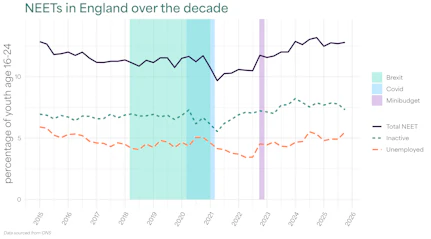
NEET rates among 16-24 year olds were falling prior to and during the COVID-19 pandemic. However, by mid-2025, they had returned to 2015 levels. Compared to 2015, a larger proportion are now economically inactive as opposed to unemployed and health-related barriers account for a growing share of the total. This suggests that new policy approaches are needed.
NEET rates are in the spotlight as the government has announced an independent investigation into youth inactivity. The government has also introduced a range of policies aimed at reducing NEET rates, including the 16-19 Bursary Fund, the Youth Jobs Grant, and commitments to a Youth Guarantee, as well as the establishment of trailblazer areas to pilot these initiatives. While these changes reflect recognition of the problem, eligibility thresholds, delayed intervention, and limited local flexibility raise questions about whether they go far enough.
Three key topics that should be considered when addressing the youth employment gap include: compound disadvantage, health and place.
Compound disadvantage
Targeting interventions at those facing multiple, overlapping disadvantages is essential for effective place-based prevention and for supporting inclusive growth. Young people are not a homogenous group, and disadvantages are not evenly distributed, and often overlap. Research conducted by Impetus identified a “triple jeopardy” of compound disadvantage:
- Young people who are eligible for free school meals in Year 11 are 66% more likely to be NEET than average.
- Those with low qualifications (below a level 2 qualification) at age 18 are 77% more likely to be NEET than average.
- Those with Special Educational Needs and Disabilities (SEND) are around 80% more likely to be NEET than average.
Economic growth alone does not automatically open doors for young people and targeted pathways are required to address the root causes locking young people out of opportunities.
Spotlight: The North East Combined Authority is using funding from the ‘Get Britain Working Trailblazer’ initiative to scale the Working Well Employability Hub. The hub brings together local authority officers, DWP, mental health services, housing associations and skill providers into single accessible settings. The model responds to the multiple, overlapping barriers young people face.
Health-related barriers
Poor health is a structural barrier that constrains economic participation. Over a quarter of NEET young people are economically inactive because of health conditions. The Keep Britain Working review uncovered that since 2019 there has been a 76% increase in economically inactive 16-24 year olds due to mental health conditions.
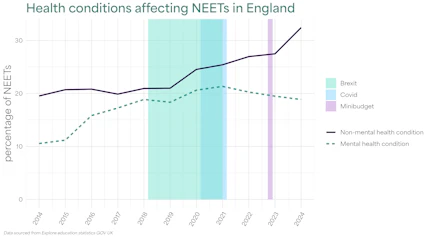
The proportion of NEET young people reporting a health condition has risen over the past decade. This shows that the current NEET challenge is part of a wider picture, and one structural component is linked to health-related barriers, which may require different policy responses from those aimed purely at increasing labour demand.
Preventative approaches that support mental health are crucial to having long-term economic payoffs. Health and the economy must be treated as intertwined systems: designing place-based interventions that integrate mental health support, employability services, and progression pathways.
Spotlight: In the West Yorkshire, the Further Education Compact is a partnership between the Combined Authority, the Mayor, and Further Education colleges. Anchored in the Local Growth Plan, the compact aligns post-16 education with local labour demands.
The role of place
Local conditions shape the opportunities young people can access, and place-based solutions are needed to give authorities the flexibility to align education, training, and employment opportunities with the needs of their communities.
NEET rates tend to be highest in the North of England and the Midlands, reflecting entrenched inequalities in local economies, transport, and investment in education, training, and employment.
These findings strengthen the case for giving local and combined authorities greater flexibility to align post-16 skills provisions with local demand. Suggested interventions include stronger employer engagement to introduce young people to workplaces and role models; short, accessible training courses to encourage rapid upskilling in sectors where demand exists locally; and providing affordable, reliable transport to young people to access education, training, and work.
Conclusion
National policy sets a framework to address the NEET challenge, but local interventions are key to reducing NEET rates and supporting inclusive growth. The Milburn Review sets out to uncover the reasons behind youth unemployment and inactivity and shape the future direction of policy to address these issues. However, ahead of these findings, there remains an opportunity to move beyond national, one-size-fits-all approaches and embed place-based preventative action. This requires:
- Enabling local areas to identify and support young people facing compound disadvantage earlier,
- Integrating health and employment support and,
- Aligning skills provision with local labour market demand,
Without this shift, there is a risk that policy will continue to address symptoms rather than the causes.
GRN articles and insights
Browse other GRN articles and insights in inclusive growth and public service reform across the UK: