The Great North looks to unlock generational investment with strength in numbers
Reflections from the Great North Investment Summit in Leeds this May.


Economic growth has been central to the North’s story over the last decade, including the fast pace of change around the region’s major cities. With the highest productivity growth in the UK (7.4%), the North has an economy that, collectively, compares to any large population centre in Europe, with four million skilled workers and eight of the world’s top 200 universities.
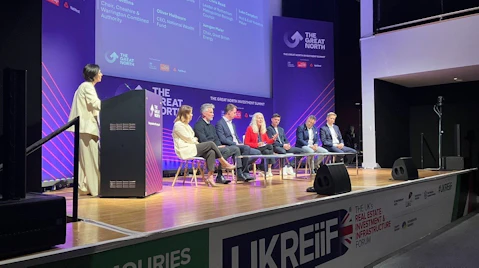
It is this scale of opportunity which is at the heart of the Great North, the collective of Mayors and Leaders which works to unlock growth through collaboration. The Growth and Reform Network has been working with the Great North to support their programme since 2025, including the investment prospectus for the region produced by the GRN with its partner Metro Dynamics. It was this Prospectus which was the centrepiece for the inaugural Great North Investment Summit, held in Leeds this May.
The sense of positivity at the Summit was tangible; investors, regional and national government together recognising this moment as one which is critical for the North and for the UK – with generational investment committed by the Chancellor, and devolution continuing to progress.
Connecting the North
£55 billion has now been committed to connect the North like never before, with Northern Powerhouse Rail moving forwards and funding for bus franchising within city regions. These are significant projects for communities, their everyday experience and their trust in politics to deliver results. And so we saw Tracy Brabin on-stage in Leeds, whipping up a packed auditorium about the future delivery of mass transit in West Yorkshire, and Andy Burnham using the Bee Network as an example of what devolution can achieve.
In very practical terms for investors, the transport funding will shrink the region, linking more of the skilled workforce to a greater range of job opportunities and connecting innovative firms and potential new supply chains. As one example, it will take just 42 minutes from Manchester to Leeds via the upgraded TransPennine Express. In this context, it’s clear why cooperation between Mayors is vital. As Leeds takes forward its South Bank development and new town-sized housing delivery, not far from the Summit venue of the Royal Armouries, greater numbers of future residents could be commuting across the North for work, whether to the Government’s new digital campus in Manchester, to lab space in York Central, or to advanced manufacturing sites around the Don Valley Corridor.
Being able to reliably and quickly get around a region which is less than a third of the size of New York State is a prerequisite for attracting greater capital and improving business performance. This connection and close collaboration also allows regions to package up projects for investment, which on their own would be too small to interest institutional investors but together can create long-term projects. This could include local energy infrastructure, housing, and employment space development.
New funders, new relationships
This positivity and new sense of potential was not just in the messaging of Mayors on stage, but was shared by investors taking part in the day. There is clear interest in the North as a proposition, and as one which has the kind of scale of ambition and potential returns – in jobs, business creation, and GDP – that a decade ago were the preserve of Greater London and perhaps spinouts from the Golden Triangle of Cambridge and Oxford.
As the Office for Investment – a collaborator on the Great North Investment Prospectus – puts the final pieces of its new regional structure in place, it’s also clear that government of all types is building capacity to be able to secure investment that works for its places. Andrew Dowler, Head of Government Relations for Blackstone in Europe, spoke about the range of different sources of funding that could be available to the North, but that many aren’t aware of how to seek these out and how to work collaboratively to ensure their involvement.
UK Private Capital estimates there is nearly £190 billion ready to be invested in the UK by various funds, over the next three to five years. There are examples of innovative partnerships already delivering across the North itself, such as Legal and General’s work to deliver affordable housing and regeneration, and the North are seeking early involvement to shape schemes in ways that work for investors as well as communities. NatWest, headline sponsors of the Summit, announced its own £20 billion investment fund, focused on the North and on delivering more productive regional economies.
So, funding exists, but regional government recognises that there is a steep learning curve required to attract this investment and deliver impactful projects. Many are working quickly to fill in the gaps on the devolution map and to set up institutions which can manage risk and deliver on the integrated settlements already achieved by Greater Manchester, Liverpool City Region and others. The Chancellor’s recent commitment to consider greater fiscal devolution – to give regions the flexibility to reassign more revenue – puts this capability in even greater demand. The dialogue between Mayoral teams and investors to shape long-term capital funding which delivers projects for residents but also de-risks those projects for funding partners will be a key part of future success.
Delivering skills into an evolving economy
Another key topic, brought forward by employers and representatives from chambers of commerce at the Summit, is how to bring along communities and particularly young people on the North’s growth journey. Darren Davidson, VP at Siemens Energy, spoke about the demand for vocational skills and apprenticeship training, citing welding as an example skill with a huge range of applications in offshore wind and green energy alone, but one for which the region has lost its muscle memory from the industrial heritage of the North East shipyards.
Local skills plans are vital to meet these gaps, as is connecting the North to enable movement of skilled workers from opportunity to opportunity, but Darren also raised how places communicate opportunity and routes to work to young people and ensure that access to apprenticeships is available to those from deprived backgrounds. Getting this right, and ensuring that the North’s growth story is one that young people from all backgrounds see themselves in, may be the most important investment of all.

GRN articles and insights
Browse other GRN articles and insights in inclusive growth and public service reform across the UK: